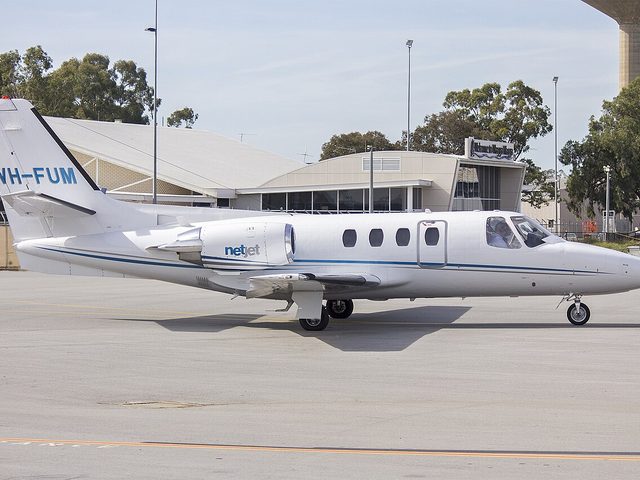
Cessna 1sp
Twin Jet· 208 globally registered
The Cessna Citation I, introduced in 1972 as the Citation 500, was the production version of the revolutionary Citation prototype that launched the light business jet category. Cessna's gamble on a straight-wing, modestly-powered twin-jet designed for owner-pilots rather than corporate flight departments proved transformative. The Citation became the best-selling business jet family in history, with over 8,000 delivered across all variants. The original Citation I prioritized simplicity and economy over raw speed, cruising at 340 knots with a range of 1,300 nautical miles, making it accessible to operators transitioning from piston twins. Powered by two Pratt & Whitney JT15D-1A turbofans producing 2,200 pounds of thrust each, the Citation I could operate from runways as short as 3,000 feet and climb directly to FL410, capabilities that opened thousands of airports to jet traffic for the first time. Its docile handling characteristics and relatively low operating costs made it a favorite of small corporations, air ambulance operators, and freight carriers. The type remained in production until 1985, with 689 built, and many still fly today in cargo, charter, and private roles. The Citation I established design principles (high wings for cabin space, straight wings for short-field performance, and twin Williams or P&W engines in the 2,000-3,000 pound thrust class) that Cessna refined through the Citation II, Bravo, CJ series, and beyond. Its success proved that a market existed below the traditional midsize jet segment, a lesson that reshaped the entire business aviation industry. SkyMeter has tracked 173 flights across 60 airframes and 58 operators, with CESSNA AIRCRAFT LEASING LLC the largest observed operator.
Safety in context
The incident rate counts flights with ANY safety event detected by SkyMeter: go-arounds (a routine response, not a failure), unstable-approach gate flags (advisory thresholds), rejected takeoffs (the system working as designed), and runway events. It is NOT an accident rate or fatality rate. For accident statistics, refer to the NTSB Aviation Accident Database (USA) or the Aviation Safety Network. See methodology for what each event type measures.
Performance
Speed envelope & approach
Dimensions
Airframe geometry
Weight & identification
Operating limits
Top operators
By fleet size · last 7 days


Safety profile
Flagged flights · last 7 days
Family
Related variants
Recent incidents
Flagged flights of C501
Recent flights
Real flights of C501 · airborne ≥ 20 min

